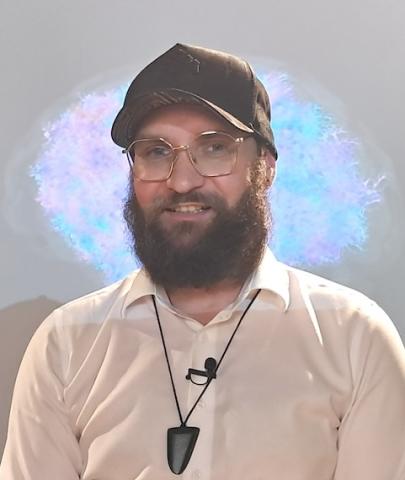
As a youngster, Mitchell Head was all about high performance. Back then his focus was driving fast cars, and refining them with his dad, to win races. Racing with Toyota, Mitchell was a top young driver, competing in karting, circuit, and tarmac rally events around the motu. After high school, he chose a degree in mechanical engineering, aiming to build even faster cars.
Fast-forward to today and Mitchell (Ngāti Mahuta, Ngāti Naho) is still working in high performance, but now his mahi is understanding how humans can excel, heal and overcome adversity.
“Early in my racing career, I realised that human performance is just as important as the mechanics of a car when determining whether you win or lose. I wanted to understand how to tune my own performance just like we do for cars. So, I changed my degree from engineering to psychology to find out how humans can improve performance,” says Mitchell.
Today, Mitchell is a neuroscientist and neuroengineer co-leading the team at Te Kura Rau Mahara, Waikato Wearables Research Lab, and is a senior lecturer in Mechatronics at the University of Waikato.
Mitchell’s early research was focused on understanding the nature of consciousness. “If you work out how to tune consciousness you can change someone’s whole experience. You can help people be happier, you can reduce depression and anxiety and improve performance in things like sport,” he says.
A focus of his early research was waiata and understanding how the power of sound oscillation affected consciousness. Using waiata, Mitchell uncovered a technique that can modulate the areas of the brain that underlie consciousness. “We worked out that you can stimulate different parts of the brain using sound. That really sat well with me because instead of using drugs and medicine that can have off-target effects, we found that you can use sound vibrations to target different areas of the brain and this can help people recover from all sorts of things like depression and addiction,” he says.
Mitchell says these findings were especially satisfying because it underscores what Indigenous people have known all along; that the energy of vibration is foundational to the existence of organisms.
“I found that oscillations and different vibrations are what makes consciousness in animals. When all these pieces of the brain are vibrating together, they integrate and that’s what causes a person to experience consciousness.”
Mitchell advanced his research on consciousness further when he accepted a PhD scholarship and worked in the Minneapolis veterans’ hospital. During this time, he helped develop a drug to help those suffering with obesity and drug addiction. While there he found that we could target different aspects of consciousness by adjusting two drugs to help inhibit the addiction and craving centres of the brain which also improved people’s motivation.
However, Mitchell’s interest in working with Indigenous researchers was always humming away in the back of his own consciousness, knowing that rich, Indigenous understandings of consciousness are often overlooked in science. While completing a postdoctoral fellowship at the University of Minnesota’s Department of Neuroscience to accelerate learning and memory, he got a message from Rua Bioscience co-founder, Manu Caddie, that made him jump at the chance to return home to work.
“Manu reached out to me about exciting opportunities to study medicinal effects of taonga species in Aotearoa and later I connected with a community dealing with amphetamine addiction and was able to support them to develop a study to help with addiction. This was an awesome chance to collaborate with our own Indigenous groups as well as Western scientists.’”
During this time, he worked alongside colleagues at Te Kotahi Research Institute, Manaaki Whenua and Indigenous researchers from the East Coast to develop a trial using a treatment made with native magic mushrooms for people suffering with meth addiction. This trial is now in its final stages.
Today, Mitchell and others in the Te Kura Rau Mahara team are integrating their engineering, computer science and neuroscience knowledge to create technologies that assist people to overcome adversity and perform at higher levels. And it seems almost preordained that Mitchell’s first love – fast cars – might now become part of his mahi at the lab.
Formula 1 is interested in the headset he built to measure and tune brain functioning so they can improve driver’s performance. “We have a driving simulator, and we are measuring the brain when people are driving well and trying to work out what the brain looks like when it is in that flow state,” says Mitchell.
“What ties the team together at Te Kura Rau Mahara is our interest in helping people. We are fortunate that we have a lab which enables us the freedom to explore many ways of solving problems. The freedom to take a Te Ao Māori view and interweave this with a Western approach to science allows us to take out-of-the-box ideas and explore them for the betterment of all people is very powerful,” he says.